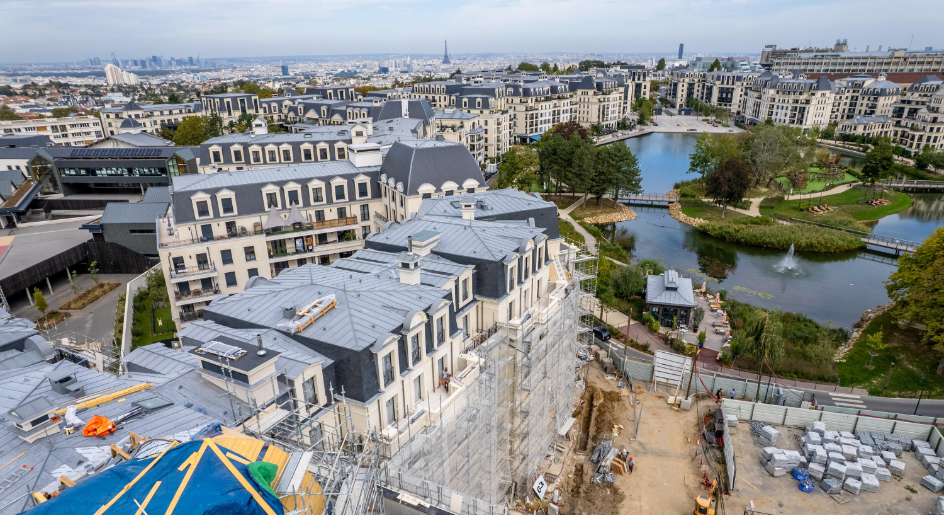
The town of Bessancourt's call for tenders for the Coupillers district was to build the town on top of the town, while retaining a village identity, through urban planning that favors houses and intermediate housing.
The winning A26 project draws on several years of upstream work with residents to sketch out the beginnings of their future living environment. In a landscaped environment rich in varied housing typologies (houses, stacked houses and collective housing), the common thread of the project intends to preserve the village identity by drawing inspiration from the garden cities of the late XIXᵉ century.
In addition to the construction of 251 housing units, phased to manage the various relocations necessitated by the demolition of 181 units, the A26 agency is developing an urban polarity that will radiate throughout the neighborhoods and even the city as a whole. The aim is to provide a dynamic meeting place, with facilities for concerts, markets, flea markets, school fairs, etc.
Within the neighborhood, particular attention is paid to the landscaping, which, as well as offering large green spaces and water features, encourages soft mobility to meet the diverse expectations of everyone (walking, sports, relaxation, games, meetings, etc.).
Work on the typology of the dwellings provided the opportunity to imagine intermediate housing that plays with volumes to identify it as a single-family home. The overall impression is that of a garden city made up of houses of varying sizes.
Scheduled to take place over the next 7 years, the project will benefit fully from A26's experience in BIM management. This approach, which extends the use of the BIM model to the city and the region, enables designers, decision-makers and residents alike to be immersed in the future district. At every stage in the development of a project, even in the very early stages, it offers the possibility of integrating all available data (GIS, concessionary networks, regulations, etc.) or data created (urban plans, capacity studies, feasibility studies, the project, etc.). It thus leads to a project that is shared and accepted by all, and ensures cost control.