THERMAL RENOVATION OF AQUATIC CENTERS
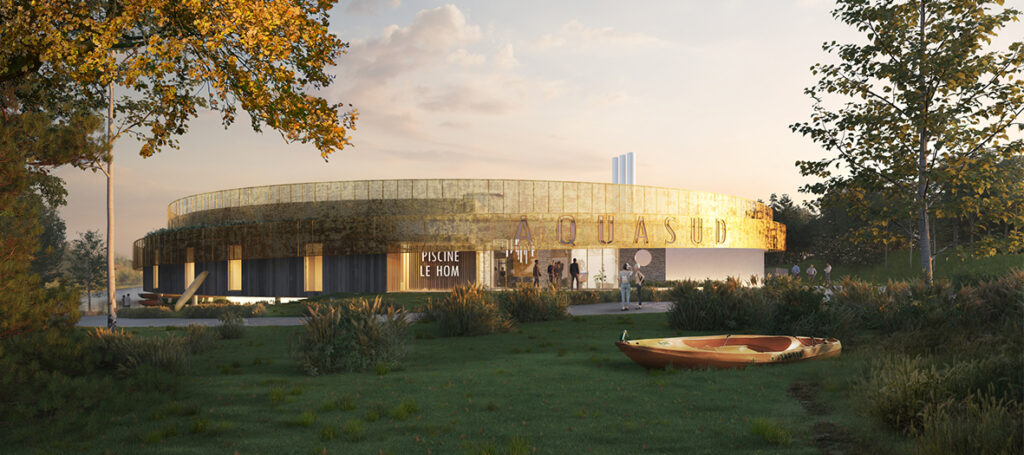
In the new commune of Le Hom (Calvados), we have just delivered a fully renovated aquatic center. Through our Sport division, the Group has developed recognized expertise in helping local authorities reduce the energy consumption of their sports facilities.
Particularly vulnerable in times of rising energy prices, aquatic facilities are such a drain on local finances that several communities were forced to close them last winter. Against this backdrop, more and more communities are taking action to renovate their aquatic centers, like the new commune of Le Hom. We have succeeded in considerably reducing the building's energy requirements, through a combination of architectural choices and the installation of more efficient systems.
ALLYING ARCHITECTURAL DESIGN AND ENERGY EFFICIENCY
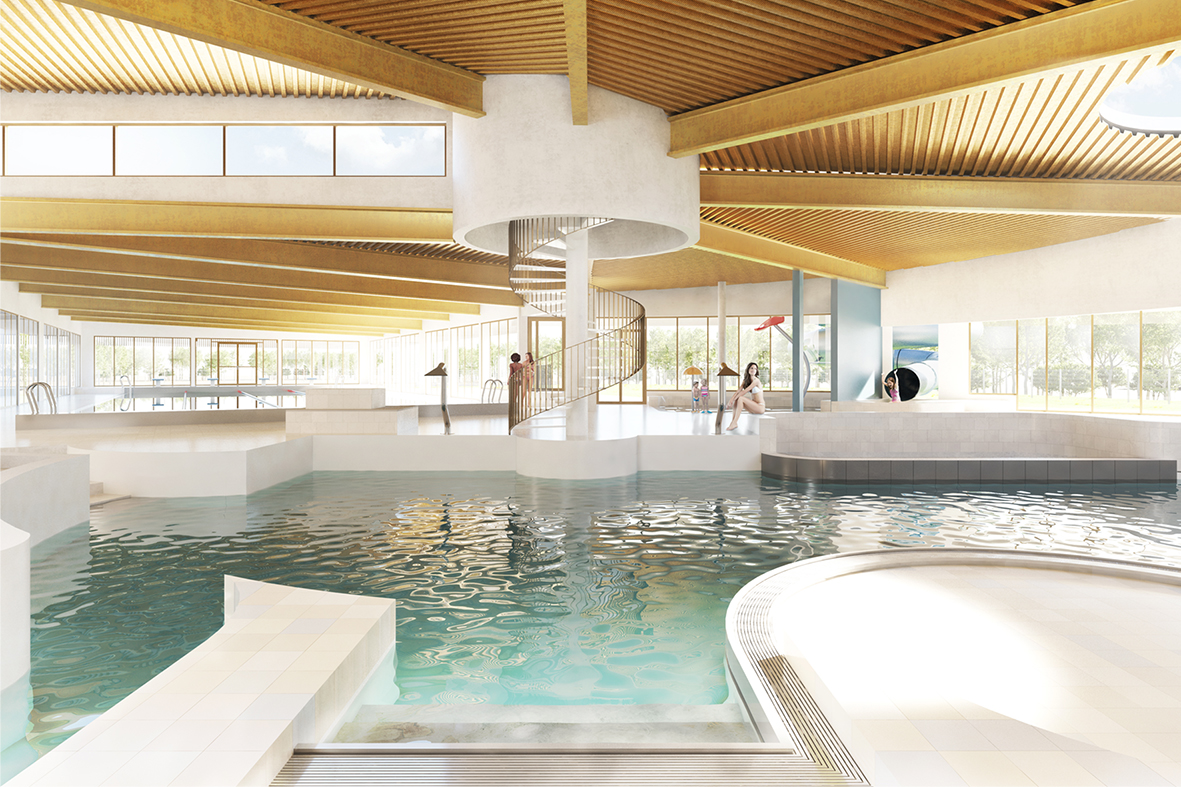
"When designing an aquatic center, there's one golden rule: its exposure to the sun ", explains Thierry Deschaumes, Architect and Head of the Sports division, "it's vital to optimize the orientation of these energy-intensive facilities, to store as much energy as possible through solar gain". We therefore carried out several sunlight simulation studies, both to ensure that the center had the right exposure, and to position the new 'wellness' and 'leisure' areas commissioned by the municipality. We therefore opted for a large glass roof to maximize the sun's energy contribution while limiting the need for artificial lighting in the bathing areas. Light-colored wall coverings also enhance light reflection inside the building.
In this way, we transformed every technical constraint into an architectural proposal: to avoid glare effects on the pools, for example, the facade was redesigned and now incorporates a metal strip acting as a sunshade.
Finally, we opted for thermal insulation from the outside: "this is currently the most effective process for reducing a building's energy consumption", explains Thierry Deschaumes, "it also enables us to take full advantage of the aquatic centers' activity by recovering the thermal calories generated".
SETTING UP MORE EFFICIENT SYSTEMS
In addition to a more energy-efficient architectural design, the emphasis was placed on modernizing the systems. The previous boiler has been replaced by two wood-fired boilers, which will provide heating for the building, domestic hot water and the pools. A system for recovering heat from air dehumidification will also meet the thermal needs of the pool areas.
Artificial lighting is now based on LED technology, which consumes half the energy of previous systems, and can be modulated according to need.
All sanitary equipment (flush toilets, urinals, showers and surface cleaning equipment) has been converted and fitted with hydro-economy solutions, enabling a 30% reduction in actual consumption compared with the reference consumption (3,500 m3 of water per year compared with 4,900 m3 previously).
Finally, a centralized technical management system has been integrated to facilitate control of the new installations. This system will enable the heating systems in the spaces and pools to be modulated thanks to real-time monitoring.
RECOGNIZED EXPERTISE AND KNOW-HOW
This new project illustrates our agency's ability to take on complex energy-efficiency renovation projects for aquatic centers. In total, the agency has delivered around ten facilities since 2016, while two other projects are still underway, such as the famous Bains des Docks in Le Havre. Necessary to ease the financial burden on local authorities, these projects call for specific expertise and solutions tailored to the specific characteristics of the area. " We always work closely with the local ecosystem," explains Thierry Deschaumes, "in Gaillon, in the neighboring department of Eure, for example, we approached the establishment in charge of the nearby wastewater treatment plant to set up an ecological heating system using a methanization process for residual sludge to meet the aquatic center's electricity and heat requirements.
The project, which included the creation of two new areas - "bien-être" and "ludique" - the redefinition of the aquatic center's identity and its thermal renovation, took 20 months to complete at a cost of 5.5 million euros.